
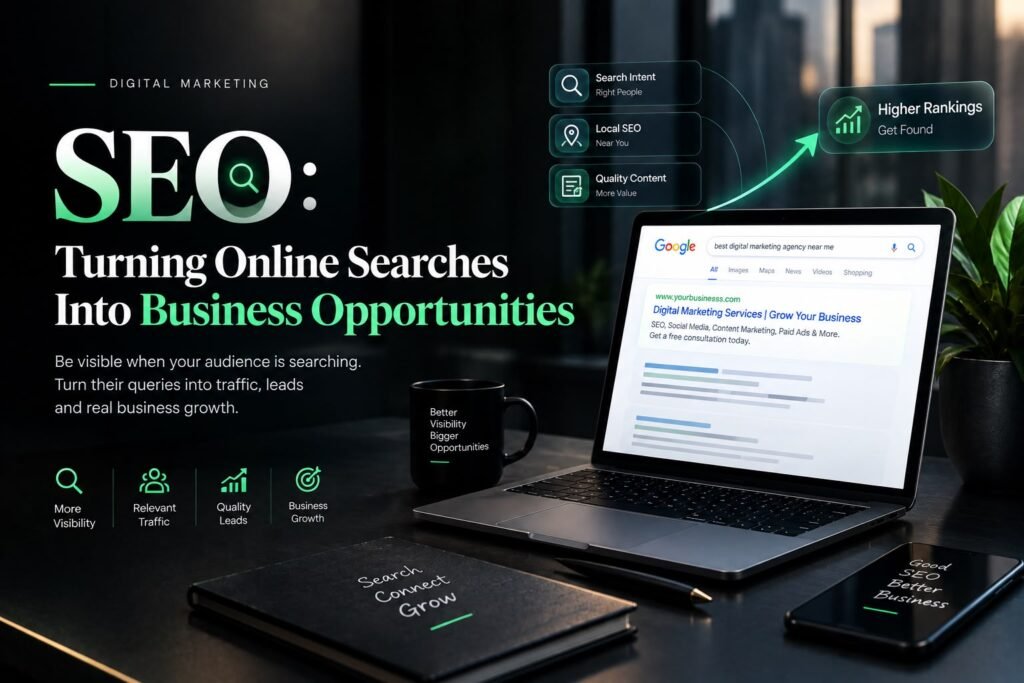
SEO: Turning Online Searches Into Business Opportunities
Every day, people search online for products, services, information, solutions, and businesses they can trust. A customer looking for a service may begin with a simple search, compare several websites, read reviews, explore social media, and eventually decide which business deserves their attention.
This creates a powerful opportunity for businesses.
Search Engine Optimisation, or SEO, helps businesses become visible when potential customers are actively searching for what they offer.
But SEO is more than simply ranking a website on Google. When approached strategically, it can become a long-term business growth channel — bringing relevant traffic, building credibility, generating enquiries, and creating opportunities for meaningful conversions.
What Is SEO?
SEO is the process of improving a website and its content so that search engines can better understand, evaluate, and present it to users.
Search engines aim to provide users with the most useful and relevant results. SEO helps businesses communicate their relevance through high-quality content, appropriate keywords, technical website optimisation, user experience, and other factors.
The objective is simple:
Be visible when the right customer is looking for the right solution.
Instead of interrupting someone with an advertisement, SEO allows businesses to appear naturally when there is already an existing search intent.
Why Search Visibility Matters
Imagine someone searching for a service that your business provides.
If your website appears prominently in the search results, you have an opportunity to introduce your brand to a potential customer. If your business does not appear, that opportunity may go to a competitor.
This is why search visibility matters.
Customers often use search engines at different stages of their decision-making process. They may search for general information first, compare available options later, and eventually search for a specific service or brand.
A strong SEO strategy helps a business remain visible throughout this journey.
SEO Attracts Intent-Driven Traffic
One of the most valuable aspects of SEO is search intent.
Someone who searches for “what is digital marketing” may simply be looking for information. Someone searching for “digital marketing agency near me” has a much stronger commercial intent.
Understanding this difference allows businesses to create content for different stages of the customer journey.
SEO is therefore not about attracting as many visitors as possible.
It is about attracting the right visitors.
Relevant traffic has a greater potential to become an enquiry, customer, subscriber, or long-term brand connection.
The Role of Keywords
Keywords are an important part of SEO because they help connect what people search for with the content a business provides.
However, modern SEO is not about repeatedly placing the same keyword throughout a page.
Effective keyword strategy begins with understanding what your audience is actually searching for.
Businesses should consider:
- What questions are customers asking?
- What services are they searching for?
- What problems are they trying to solve?
- What phrases are commonly used in their industry?
- What information do they need before making a decision?
When content is created around genuine search behaviour, it becomes more useful to both users and search engines.
Content Is the Foundation of SEO
A technically optimised website is important, but valuable content is what gives people a reason to visit and stay.
Blogs, service pages, guides, case studies, FAQs, and educational resources can all contribute to a strong SEO strategy.
Good content should answer questions clearly, demonstrate expertise, and provide genuine value.
Instead of creating content simply because a keyword has search volume, businesses should ask:
“Does this content genuinely help my potential customer?”
When the answer is yes, SEO becomes more than a ranking exercise. It becomes a way of building trust.
Website Experience Matters
SEO does not exist separately from the user experience.
A website may attract visitors through search, but if it is slow, confusing, difficult to navigate, or poorly designed, those visitors may leave without taking action.
A professional SEO strategy therefore considers elements such as:
- Website speed
- Mobile responsiveness
- Clear navigation
- Readable content
- Internal linking
- Strong calls to action
- Secure website experience
- Easy access to important information
The goal is not simply to bring people to a website.
The goal is to give them a reason to stay.
Local SEO and Business Growth
For businesses serving a specific city, region, or local community, local SEO can be particularly valuable.
People frequently search for businesses based on their location, such as services “near me” or within a particular city.
A strong local SEO presence can help businesses improve their visibility among nearby customers who are actively looking for their services.
For local businesses, factors such as accurate business information, location-focused content, customer reviews, and a well-optimised online presence can contribute to stronger local visibility.
SEO Builds Long-Term Brand Authority
Paid advertising can provide immediate visibility, but SEO has the potential to create lasting organic presence.
When a website consistently publishes valuable content and provides a strong user experience, it can gradually build authority within its industry.
Over time, appearing consistently in relevant searches can also increase brand familiarity.
A person may not become a customer the first time they see your business. But repeated exposure can create recognition — and recognition can eventually develop into trust.
This makes SEO a powerful part of long-term brand building.
Measuring SEO Success
SEO success should not be measured only by rankings.
A professional SEO strategy looks at the bigger picture.
Important indicators can include:
- Organic website traffic
- Search visibility
- Keyword performance
- Quality of website visitors
- Enquiries and leads
- Conversion rates
- User engagement
- Landing-page performance
The ultimate question is not simply:
“Did we rank?”
It is:
“Did our visibility create meaningful business value?”
This shift in perspective helps businesses focus on outcomes rather than vanity metrics.
SEO Is an Investment, Not a Shortcut
One of the biggest misconceptions about SEO is expecting instant results.
SEO is generally a long-term process. It requires research, content development, technical improvements, optimisation, monitoring, and continuous refinement.
Search engines constantly evolve, competitors continue creating content, and customer behaviour changes over time.
That is why successful SEO requires consistency.
The businesses that approach SEO as an ongoing investment are better positioned to build sustainable search visibility and long-term digital value.
Turning Searches Into Opportunities
Every search represents a question, a need, a problem, or an intention.
For businesses, that search can represent an opportunity.
The role of SEO is to connect those moments of intent with the right information, service, or solution.
When strategy, content, technical optimisation, user experience, and business goals work together, SEO becomes much more than a digital marketing technique.
It becomes a bridge between what people are searching for and what your business can provide.
Final Thoughts
SEO is not about chasing algorithms or trying to manipulate search results.
At its best, SEO is about understanding people.
Understand what they search for.
Understand why they search for it.
Create content that genuinely helps them.
Build a website that provides a smooth experience.
And make it easy for the right people to take the next step.
In a competitive digital landscape, visibility creates opportunity.
SEO helps your business be discovered at the moment your audience is already looking — turning online searches into real conversations, valuable leads, and long-term business growth.